A-LEVEL GEOGRAPHY REVISION: EDEXCEL
  • Globalisation
    • 3.1: Globalisation, past and present >
      • 3.1A What is Globalisation?
      • 3.1B Transport Technology and Globalisation
      • 3.1C Communication Technology
    • 3.2 Political and Economic Decision Making >
      • 3.2A International Organisations
      • 3.2B National Governments
      • 2C SEZs and Attitudes to FDI
    • 3.3 Degree of Globalisation >
      • 3A Measuring the Degree of Globalisation
      • 3B Role of TNCs
      • 3C Switched Off Locations
    • 3.4 Winners and Losers >
      • 3.4A Benefits and Costs of Global Shift
      • 4B Environmental Problems
      • 4C Deinstrialisation and its Problems
    • 3.5 Migration and Globalisation >
      • 5A Rural-Urban Migration and Megacities
      • 5B International Migration
      • 5C Costs and Benefits of Migration
    • 3.6 Global Culture >
      • 6A Cultural Diffusion
      • 6B Cultural Erosion
      • 6C Opposition to Globalisation
    • 3.7 The Development Gap >
      • 7A Economic and Social Measures
      • 7B Trends, Winners and Losers
      • 7C Economic Development and Environmental Impact
    • 3.8 Tensions from Globalisation >
      • 8A Racial Tensions
      • 8B Controlling the Spread of Globlisation
      • 8C Attempts to Retain Cultural Identity
    • 3.9 Ethical and Environmental Concerns >
      • 9A Local Sourcing
      • 9B Fair Trade and Ethical Consumption
      • 9C Recycling
  • Regenerating Places
    • 4A.1 Economies >
      • 4A.1A Classifying Economic Activity
      • 4A.1B Economic Activity and Social Factors
      • 4A.1C Quality of Life Indices
    • 4A.2 Changing Places >
      • 4A.1A Changing Function and Characteristics
      • 4A.2B Reasons for the Change
      • 4B.2C Measuring Change
    • 4A.3 Past and Present >
      • 3A Regional and National Influences
      • 3B International and Global Influences
      • 3C Identity
    • 4A.4 Economic and Social Inequalities >
      • 4A Successful Regions
      • 4B Less Successful Regions
      • 4C Priorities for Regeneration
    • 4A.5 Lived Experience and Engagement >
      • 5A Engagement
      • 5B Lived Experience
      • 5C Conflicts
    • 4A.6 Evaluating the need for Regeneration >
      • 6A Stats
      • 6B Media Representation
      • 6C Representation and Need for Regeneration
    • 4A.7 Government Policy >
      • 7A Infrastructure Investment
      • 7B Planning Policies and Stuff
      • 7C Negative Effects of Governmet Policys
    • 4A.8 Local Governments >
      • 8A Sympathetic Business Environments
      • 8B Partnerships
      • 8C Regeneration Strategies
    • 4A.9 - Rebranding >
      • 9A Re-imaging
      • 9B Rebranding Deinstrialised Places
      • 9C Rebranding Rural Areas
    • 4A.10 How successful is Regeneration? >
      • 10A Measuring the Success of Regeneration
      • 10B Success and Social Progress
      • 10C Improving Living Environments
    • 4A.11 Urban Stakeholders >
      • 11A Successful or Not?
    • 4A.12 Rural Stakeholders >
      • 12A Restructuring and Contested Decisions
    • Scarborough and High Wycombe
  • Superpowers
    • 7.1 Causes of Geopolitical Power >
      • 7.1A Defining characteristics of powers
      • 7.1B Hard and Soft Power Spectrum
      • 7.1C Changing Importance of 7A and 7B
    • 7.2 Patterns of Power >
      • 7.2A Imperial Era
      • 7.2B Indirect Control
      • 7.2C Geopolitical Stability and Risk
    • 7.3 Emerging Powers >
      • 7.3A The Emerging Powers
      • 7.3B Strengths and Weaknesses
      • 7.3C Development Theory
    • 7.4 Superpowers and the Global Economy >
      • 7.4A - Influence through IGOs
      • 7.4B TNCs
      • 7.4C Cultural Influence
    • 7.5 Superpowers and International Decision Making >
      • 7.5A Global Action
      • 7.5B Alliances
      • 7.5C the United Nations
    • 7.6 Superpowers and the Physical Environment >
      • 7.6A Resource Demands
      • 7.6B Environmental Governance
      • 7.6C Middle-Class Consumption on Emerging Powers
    • 7.7 Spheres of Influence >
      • 7.7A Tension over Physical Resources
      • 7.7B Intellectual Property
      • 7.7C Political Spheres of Influence
    • 7.8 Developing Nations >
      • 7.8A Emerging Powers and the Developing World
      • 7.8B Asian Tensions
      • 7.8C Middle East Tensions
    • 7.9 Challenges to Existing Superpowers >
      • 7.9A Economic Problems
      • 7.9B Costs of Being a Superpower
      • 7.9C Future Power Balance
  • Health, Human Rights and Intervention
    • 8.1 Human Development? >
      • 8.1A GDP and Human Development
      • 8.1B Best Development Goals?
      • 8.1C Education
    • 8.2 Variations in Health and Life Expectancy >
      • 8.2A Variations in the Developing World
      • 8.2B Variations in the Developed World
      • 8.2C: Variations within Countries
    • 8.3 Governments and IGOs >
      • 8.3A The relationship between economic and social development
      • 8.3B IGOs and Development
      • 8.3C MDGs and SDGs
    • 8.4 International Law and Agreements >
      • 8.4A the UDHR
      • 8.4B the ECHR
      • 8.4C The Geneva Convention
    • 8.5 Global Human Rights Variations >
      • 8.5A Human Rights Vs Economic Development
      • 8.5B Democratic Freedom
      • 8.5C Political Corruption
    • 8.6 Rights Variations Within Countries >
      • 8.6A Gender and Ethnic Differences
      • 8.6B Health and Education Variations
      • 8.6C Demands for Equality
    • 8.7 Geopolitical Intervention >
      • 8.7A Types of Interventions
      • 8.7B Governments, IGOs and NGOs
      • 8.7C Intervention and Sovereignty
    • 8.8 the Positive and Negative of Development >
      • 8.8A About Development Aid
      • 8.8B Does Aid Work?
      • 8.8C Negatives of Economic Development
    • 8.9 Military Aid and Intervention >
      • 8.9A Military Interventions
      • 8.9B Military Aid
      • 8.9C Direct Military Intervention
    • 8.10 Measuring Success of Interventions >
      • 8.10A Variables for Measuring Success
      • 8.10B Democracy as 'Success'
      • 8.10C - Economic Growth as Success
    • 8.11 Success of Development Aid? >
      • 8.11A Successes and Failures
      • 8.11B Aid and Equality
      • 8.11C Aid as Foreign Policy
    • 8.12 Military Interventions >
      • 8.12A Costs of Recent Interventions
      • 8.12B Non-Military may be Better?
      • 8.12C - Consequences of Inaction
  • Tectonic Processes and Hazards
    • 1.1 Causes of Tectonic Hazards >
      • 1.1A Distribution and Causes
      • 1.1B Distribution of Boundaries
      • 1.1C Intra-Plate Stuff
    • 1.2 Theoretical Frameworks >
      • 1.2A and B Plate Tectonics
      • 1.2C Impacts on Hazards
    • 1.3 Explaining Tectonic Hazards >
      • 3A Hazards from Earthquakes
      • 3B Hazards from Volcanoes
      • 1..3C - Tsunami
    • 1.4 Disaster! >
      • 1.4A Definitions
      • 1.4B The PAR Model
      • 1.4C Impacts of Tectonic Hazards
    • 1.5 Tectonic Hazard Profiles >
      • 1.5A Measuring Magnitude and Intensity
      • 1.5B Hazard Profiles
      • 1.5C Profile Examples
    • 1.6 Development and Governance >
      • 1.6A Inequality
      • 1.6B Governance and Geographical Factors
      • 1.6C Disaster Context
    • 1.7 Trends and Patterns >
      • 1.7A Trends since 1960
      • 1.7B Megadisasters
      • 1.7C Multiple Hazard Zones
    • 1.8 Theoretical Frameworks >
      • 1.8A - Prediction and Forecasting
      • 1.8B The Hazard Management Cycle
      • 1.8C Park's Model
    • 1.9 Tectonic Hazard Impacts >
      • 1.9A Disaster Modification
      • 1.9B Modifying Vulnerability
      • 1.9C Modifying Loss
  • Coastal Landscapes and Change
    • 2B.1 The Littoral Zone >
      • 2B.1A Parts of the Littoral Zone
      • 2B.1B Classifying Coasts
      • 2B.1C Rocky Coasts and Coastal Plains
    • 2B.2 Geological Structure >
      • 2B.2A Concordant and Discordant
      • 2B.2B Their Morphology
      • 2B.2C Geological Structure and Cliff Profiles
    • 2B.3 Rates of Coastal Recession >
      • 2B.3A Lithology
      • 2B.3B Rock Strata and Complex Cliff Profiles
      • 3C Vegetation Stabilisation of Sediment
    • 2B.4 Marine Erosion >
      • 4A Waves and Beach Morphology
      • 4B Wave Erosion Processes
      • 4C Coastal Landscapes Produced by Erosion
    • 2B.5 Sediment Transport and Deposition >
      • 5A Sediment Transportation
      • 5B Depositional Landforms
      • 5C The Sediment Cell Model
    • 2B.6 Sub-Aerial Processes >
      • 6A Weathering
      • 6B Mass Movement
      • 6C Landforms Produced by Mass Movement
    • 2B.7 Sea Level Change >
      • 7A Long-Term Sea Level Change
      • 7B Emergent and Submergent Coastlines
      • 7C Contemporary Sea Level Change
    • 2B.8 Rapid Coastal Retreat >
      • 8A Human Activity and Coastal Recession
      • 8B Subaerial Processes Work Together
      • 8C Temporal Variations in Coastal Recession
    • 2B.9 Coastal Flooding >
      • 9A Local Factors that Increase Coastal Flood Risk
      • 9B Storm Surges
      • 9C Climate Change and Coastal Flood Risk
    • 2B.10 Affected Communities >
      • A - Economic and Social Losses from Recession
      • B - Flooding and Storm Surges
      • C - Environmental Refugees
    • 2B.11 - Coastal Management >
      • 2.11A Hard Engineering
      • 2.11B Soft Engineering
      • 2.11C Sustainable Management
    • 2B: 12 Integrated Coastal Zone Management >
      • 2B.12A Littoral Cells
      • 2B.12B Policy Decisions
      • 2B.2C Conflicts
  • The Water Cycle
    • 5.1 Importance to Life >
      • 1A - A Closed System
      • 1B Importance and Size of Stores and Fluxes
      • 1C The Global Water Budget
    • 5.2 The drainage basin: an open system >
      • 2A - the Hydrological Cycle
      • 2B Impact of Physical Factors
      • 2C - Impact of Human Factors
    • 5.3 Water Budgets and River Systems >
      • 3.1 Water Budgets
      • 3B River Regimes
      • 3C Storm Hydrographs
    • 5.4 Deficits within the Hydrological Cycle >
      • 4A - The Causes of Drought
      • 4B - Human Activity and Drought
      • 4C - Drought and Ecosystems
    • 5.5 Flooding >
      • 5A - Meteorological Causes of Flooding
      • 5B - Human Activity and Flooding
      • 5C - Impacts of Flooding
    • 5.6 - Climate Change >
      • 6A - Inputs and Outputs
      • 6B - Stores and Flows
      • 6C - Uncertainty
    • 5.7 Causes of Water Insecurity >
      • 7A - Supply and Demand Mismatch
      • 7B - Causes of Water Insecurity
      • 7C - Finite Resources and Rising Demand
    • 5.8 Consequences and Risks of Water Insecurity >
      • 8A - Causes and Pattern of Physical and Economic Scarcity
      • 8B - Importance of Water Supplies
      • 8C - Conflicts
    • 5.9 - Managing Water Supply >
      • 9A - Hard Engineering
      • 5.9B Sustainable Water Management
      • 5.9C Integrated Drainage Basin Management
  • The Carbon Cycle
    • 6.1 Carbon and the Geological Cycle >
      • 1A Stores and Fluxes
      • 1B Formation of Geological Carbon Stores
      • 6.1C - Geological Processes Releasing Carbon
    • 6.2 Biological Processes Sequestering Carbon >
      • 6.2A Oceanic Sequestering
      • 6.2B Terrestrial Sequestering
      • 6.2C Biological Carbon
    • 6.3 Human Activity Altering the Carbon Cycle >
      • 6.3A Atmospheric Carbon
      • 6.3B Maintaining a Balanced Carbon Cycle
      • 6.3C Fossil Fuel Combustion
    • 6.4 Energy Security >
      • 6.4A The Energy Mix
      • 6.4B - Energy Consumption
      • 6.4C Energy Players
    • 6.5 Relliance on Fossil Fuels >
      • 6.5A Mismatch between Supply and Demand
      • 6.5B Energy Pathways
      • 6.5C Unconventional Fossil Fuels
    • 6.6 Alternatives to Fossil Fuels >
      • 6.6A Renewable and Recyclable Energy
      • 6.6B Biofuels
      • 6.6C Radical Technologies to Reduce Carbon Emissions
    • 6.7 Human Activity Threatening the Carbon and Water Cycles >
      • 6.7A Growing Resource Demands
      • 6.7B Ocean Acidification
      • 6.7C Forest Health
    • 6.8 Implications for Human Wellbeing >
      • 6.8A Forest Loss
      • 6.8B Rising Temperatures
      • 6.8C Declining Ocean Health
    • 6.9 Responses to Further Warming >
      • 6.9A Uncertainty about the Future
      • 9.B Adaptation Strategies
      • 6.9C Mitigation Strategies
  • List of Case Studies

7.1A - Defining Characteristics of Superpowers

Superpowers, emerging and regional powers can be defined using contrasting characteristics (economic, political, military, cultural, demographic and access to natural resources.)


Basic Definitions

  • A superpower is a country with the ability to project its dominating power and influence anywhere in the world. 
    • E.g. USA
  • Emerging superpowers are countries with a large role in one of more superpower characteristics, and with growing influence. 
    • E.g. China, Brazil, India, Russia
  • Regional powers can project dominating power and influence over other countries within the continent or region. 
    • E.g. UK, Germany, France in Europe
    • Saudi Arabia and Iran in the Middle East
    • South Africa and Nigeria in Africa 
​

Superpower Characteristics

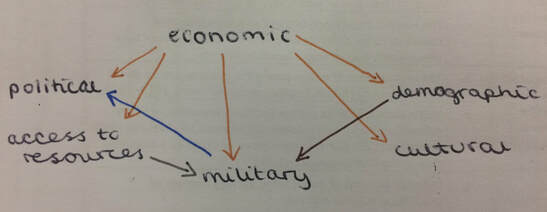
There are 6 superpower characteristics! (Economic, Political, Military, Cultural, Demographic, Natural Resources), used to define which type of power a country is. 

1) Economic
  • Large GDP, high % of international trade, currency used as reserve currency. 
  • A large GDP creates influence as a potential market and as the home of TNCs which create FDI.
  • Underpins the other 5 characteristics
  • The USA has the world's largest total GDP - $18.5 trillion
2) Political
  • The ability to influence the policies of other countries through the dominance of negotiations. (Both bilaterally and through international organisations.)
  • Many international organisations do not equally weight members. 
    • Voting power may be determined by economic contribution, historical role in founding of organisation (UN), population etc...
  • Often due to dominance in other characteristics. 
    • E.g. large economy gives it power in trade talks, military power can make countries a threat - giving them political power
3) Military
  • Military power with a global reach means they can be used to achieve geopolitical goals 
  • Global influence through blue water (ocean going) navy and drone, missile and satellite technology
  • Indicators of power: army size, defence spending, nuclear weapons, inter-continental ballistic missiles (ICBMs), size of blue water navy, being a major arms exporter, presence on/leading international military organisations.    
  • Dependent on demographic power: the number of military personnel that can be deployed
  • Dependent on economic power: budget determines investment in military technology, which increases power
  • Russia has the most active nuclear warheads (1790)
    • The USA is in second place with 1750
4) Cultural
  • The ability to influence the beliefs, values, ideology and way of life in other countries. ​
  • Achieved through: 
    • the dominance of media (films, radio, television, internet, education)
    • TNCs or migrants introducing cultural products (food, clothing, music, religion)
    • imposition of viewpoint in international agreements
  • Indicators: global spread of music, fashion, food, language, religion
  • The USA has the highest percentage of the world's 20 largest TNCs - 27%. 
5) Demographic
  • A large population -> a large diaspora and workers at TNCs
  • Assists economic power through a large market and economies of scale (so more profit). 
  • Means army can be larger. 
  • China has the largest population - 1382 million
6) Resources
  • Control of access to physical resources: energy, minerals
  • Provides inputs for economic growth
  • Means they can be exported at a high price -> economic power
    • e.g. OPEC and oil
  • May be internally located, or accessed through reliable source countries through transport pathways. 
  • Essential for military power 
Picture

Extra

  • A 'hyperpower' is a word for the one, globally dominating superpower. 
    • 1850-1910: Britain was the hyperpower
    • 1990-2010: USA the hyperpower​
Powered by Create your own unique website with customizable templates.
  • Globalisation
    • 3.1: Globalisation, past and present >
      • 3.1A What is Globalisation?
      • 3.1B Transport Technology and Globalisation
      • 3.1C Communication Technology
    • 3.2 Political and Economic Decision Making >
      • 3.2A International Organisations
      • 3.2B National Governments
      • 2C SEZs and Attitudes to FDI
    • 3.3 Degree of Globalisation >
      • 3A Measuring the Degree of Globalisation
      • 3B Role of TNCs
      • 3C Switched Off Locations
    • 3.4 Winners and Losers >
      • 3.4A Benefits and Costs of Global Shift
      • 4B Environmental Problems
      • 4C Deinstrialisation and its Problems
    • 3.5 Migration and Globalisation >
      • 5A Rural-Urban Migration and Megacities
      • 5B International Migration
      • 5C Costs and Benefits of Migration
    • 3.6 Global Culture >
      • 6A Cultural Diffusion
      • 6B Cultural Erosion
      • 6C Opposition to Globalisation
    • 3.7 The Development Gap >
      • 7A Economic and Social Measures
      • 7B Trends, Winners and Losers
      • 7C Economic Development and Environmental Impact
    • 3.8 Tensions from Globalisation >
      • 8A Racial Tensions
      • 8B Controlling the Spread of Globlisation
      • 8C Attempts to Retain Cultural Identity
    • 3.9 Ethical and Environmental Concerns >
      • 9A Local Sourcing
      • 9B Fair Trade and Ethical Consumption
      • 9C Recycling
  • Regenerating Places
    • 4A.1 Economies >
      • 4A.1A Classifying Economic Activity
      • 4A.1B Economic Activity and Social Factors
      • 4A.1C Quality of Life Indices
    • 4A.2 Changing Places >
      • 4A.1A Changing Function and Characteristics
      • 4A.2B Reasons for the Change
      • 4B.2C Measuring Change
    • 4A.3 Past and Present >
      • 3A Regional and National Influences
      • 3B International and Global Influences
      • 3C Identity
    • 4A.4 Economic and Social Inequalities >
      • 4A Successful Regions
      • 4B Less Successful Regions
      • 4C Priorities for Regeneration
    • 4A.5 Lived Experience and Engagement >
      • 5A Engagement
      • 5B Lived Experience
      • 5C Conflicts
    • 4A.6 Evaluating the need for Regeneration >
      • 6A Stats
      • 6B Media Representation
      • 6C Representation and Need for Regeneration
    • 4A.7 Government Policy >
      • 7A Infrastructure Investment
      • 7B Planning Policies and Stuff
      • 7C Negative Effects of Governmet Policys
    • 4A.8 Local Governments >
      • 8A Sympathetic Business Environments
      • 8B Partnerships
      • 8C Regeneration Strategies
    • 4A.9 - Rebranding >
      • 9A Re-imaging
      • 9B Rebranding Deinstrialised Places
      • 9C Rebranding Rural Areas
    • 4A.10 How successful is Regeneration? >
      • 10A Measuring the Success of Regeneration
      • 10B Success and Social Progress
      • 10C Improving Living Environments
    • 4A.11 Urban Stakeholders >
      • 11A Successful or Not?
    • 4A.12 Rural Stakeholders >
      • 12A Restructuring and Contested Decisions
    • Scarborough and High Wycombe
  • Superpowers
    • 7.1 Causes of Geopolitical Power >
      • 7.1A Defining characteristics of powers
      • 7.1B Hard and Soft Power Spectrum
      • 7.1C Changing Importance of 7A and 7B
    • 7.2 Patterns of Power >
      • 7.2A Imperial Era
      • 7.2B Indirect Control
      • 7.2C Geopolitical Stability and Risk
    • 7.3 Emerging Powers >
      • 7.3A The Emerging Powers
      • 7.3B Strengths and Weaknesses
      • 7.3C Development Theory
    • 7.4 Superpowers and the Global Economy >
      • 7.4A - Influence through IGOs
      • 7.4B TNCs
      • 7.4C Cultural Influence
    • 7.5 Superpowers and International Decision Making >
      • 7.5A Global Action
      • 7.5B Alliances
      • 7.5C the United Nations
    • 7.6 Superpowers and the Physical Environment >
      • 7.6A Resource Demands
      • 7.6B Environmental Governance
      • 7.6C Middle-Class Consumption on Emerging Powers
    • 7.7 Spheres of Influence >
      • 7.7A Tension over Physical Resources
      • 7.7B Intellectual Property
      • 7.7C Political Spheres of Influence
    • 7.8 Developing Nations >
      • 7.8A Emerging Powers and the Developing World
      • 7.8B Asian Tensions
      • 7.8C Middle East Tensions
    • 7.9 Challenges to Existing Superpowers >
      • 7.9A Economic Problems
      • 7.9B Costs of Being a Superpower
      • 7.9C Future Power Balance
  • Health, Human Rights and Intervention
    • 8.1 Human Development? >
      • 8.1A GDP and Human Development
      • 8.1B Best Development Goals?
      • 8.1C Education
    • 8.2 Variations in Health and Life Expectancy >
      • 8.2A Variations in the Developing World
      • 8.2B Variations in the Developed World
      • 8.2C: Variations within Countries
    • 8.3 Governments and IGOs >
      • 8.3A The relationship between economic and social development
      • 8.3B IGOs and Development
      • 8.3C MDGs and SDGs
    • 8.4 International Law and Agreements >
      • 8.4A the UDHR
      • 8.4B the ECHR
      • 8.4C The Geneva Convention
    • 8.5 Global Human Rights Variations >
      • 8.5A Human Rights Vs Economic Development
      • 8.5B Democratic Freedom
      • 8.5C Political Corruption
    • 8.6 Rights Variations Within Countries >
      • 8.6A Gender and Ethnic Differences
      • 8.6B Health and Education Variations
      • 8.6C Demands for Equality
    • 8.7 Geopolitical Intervention >
      • 8.7A Types of Interventions
      • 8.7B Governments, IGOs and NGOs
      • 8.7C Intervention and Sovereignty
    • 8.8 the Positive and Negative of Development >
      • 8.8A About Development Aid
      • 8.8B Does Aid Work?
      • 8.8C Negatives of Economic Development
    • 8.9 Military Aid and Intervention >
      • 8.9A Military Interventions
      • 8.9B Military Aid
      • 8.9C Direct Military Intervention
    • 8.10 Measuring Success of Interventions >
      • 8.10A Variables for Measuring Success
      • 8.10B Democracy as 'Success'
      • 8.10C - Economic Growth as Success
    • 8.11 Success of Development Aid? >
      • 8.11A Successes and Failures
      • 8.11B Aid and Equality
      • 8.11C Aid as Foreign Policy
    • 8.12 Military Interventions >
      • 8.12A Costs of Recent Interventions
      • 8.12B Non-Military may be Better?
      • 8.12C - Consequences of Inaction
  • Tectonic Processes and Hazards
    • 1.1 Causes of Tectonic Hazards >
      • 1.1A Distribution and Causes
      • 1.1B Distribution of Boundaries
      • 1.1C Intra-Plate Stuff
    • 1.2 Theoretical Frameworks >
      • 1.2A and B Plate Tectonics
      • 1.2C Impacts on Hazards
    • 1.3 Explaining Tectonic Hazards >
      • 3A Hazards from Earthquakes
      • 3B Hazards from Volcanoes
      • 1..3C - Tsunami
    • 1.4 Disaster! >
      • 1.4A Definitions
      • 1.4B The PAR Model
      • 1.4C Impacts of Tectonic Hazards
    • 1.5 Tectonic Hazard Profiles >
      • 1.5A Measuring Magnitude and Intensity
      • 1.5B Hazard Profiles
      • 1.5C Profile Examples
    • 1.6 Development and Governance >
      • 1.6A Inequality
      • 1.6B Governance and Geographical Factors
      • 1.6C Disaster Context
    • 1.7 Trends and Patterns >
      • 1.7A Trends since 1960
      • 1.7B Megadisasters
      • 1.7C Multiple Hazard Zones
    • 1.8 Theoretical Frameworks >
      • 1.8A - Prediction and Forecasting
      • 1.8B The Hazard Management Cycle
      • 1.8C Park's Model
    • 1.9 Tectonic Hazard Impacts >
      • 1.9A Disaster Modification
      • 1.9B Modifying Vulnerability
      • 1.9C Modifying Loss
  • Coastal Landscapes and Change
    • 2B.1 The Littoral Zone >
      • 2B.1A Parts of the Littoral Zone
      • 2B.1B Classifying Coasts
      • 2B.1C Rocky Coasts and Coastal Plains
    • 2B.2 Geological Structure >
      • 2B.2A Concordant and Discordant
      • 2B.2B Their Morphology
      • 2B.2C Geological Structure and Cliff Profiles
    • 2B.3 Rates of Coastal Recession >
      • 2B.3A Lithology
      • 2B.3B Rock Strata and Complex Cliff Profiles
      • 3C Vegetation Stabilisation of Sediment
    • 2B.4 Marine Erosion >
      • 4A Waves and Beach Morphology
      • 4B Wave Erosion Processes
      • 4C Coastal Landscapes Produced by Erosion
    • 2B.5 Sediment Transport and Deposition >
      • 5A Sediment Transportation
      • 5B Depositional Landforms
      • 5C The Sediment Cell Model
    • 2B.6 Sub-Aerial Processes >
      • 6A Weathering
      • 6B Mass Movement
      • 6C Landforms Produced by Mass Movement
    • 2B.7 Sea Level Change >
      • 7A Long-Term Sea Level Change
      • 7B Emergent and Submergent Coastlines
      • 7C Contemporary Sea Level Change
    • 2B.8 Rapid Coastal Retreat >
      • 8A Human Activity and Coastal Recession
      • 8B Subaerial Processes Work Together
      • 8C Temporal Variations in Coastal Recession
    • 2B.9 Coastal Flooding >
      • 9A Local Factors that Increase Coastal Flood Risk
      • 9B Storm Surges
      • 9C Climate Change and Coastal Flood Risk
    • 2B.10 Affected Communities >
      • A - Economic and Social Losses from Recession
      • B - Flooding and Storm Surges
      • C - Environmental Refugees
    • 2B.11 - Coastal Management >
      • 2.11A Hard Engineering
      • 2.11B Soft Engineering
      • 2.11C Sustainable Management
    • 2B: 12 Integrated Coastal Zone Management >
      • 2B.12A Littoral Cells
      • 2B.12B Policy Decisions
      • 2B.2C Conflicts
  • The Water Cycle
    • 5.1 Importance to Life >
      • 1A - A Closed System
      • 1B Importance and Size of Stores and Fluxes
      • 1C The Global Water Budget
    • 5.2 The drainage basin: an open system >
      • 2A - the Hydrological Cycle
      • 2B Impact of Physical Factors
      • 2C - Impact of Human Factors
    • 5.3 Water Budgets and River Systems >
      • 3.1 Water Budgets
      • 3B River Regimes
      • 3C Storm Hydrographs
    • 5.4 Deficits within the Hydrological Cycle >
      • 4A - The Causes of Drought
      • 4B - Human Activity and Drought
      • 4C - Drought and Ecosystems
    • 5.5 Flooding >
      • 5A - Meteorological Causes of Flooding
      • 5B - Human Activity and Flooding
      • 5C - Impacts of Flooding
    • 5.6 - Climate Change >
      • 6A - Inputs and Outputs
      • 6B - Stores and Flows
      • 6C - Uncertainty
    • 5.7 Causes of Water Insecurity >
      • 7A - Supply and Demand Mismatch
      • 7B - Causes of Water Insecurity
      • 7C - Finite Resources and Rising Demand
    • 5.8 Consequences and Risks of Water Insecurity >
      • 8A - Causes and Pattern of Physical and Economic Scarcity
      • 8B - Importance of Water Supplies
      • 8C - Conflicts
    • 5.9 - Managing Water Supply >
      • 9A - Hard Engineering
      • 5.9B Sustainable Water Management
      • 5.9C Integrated Drainage Basin Management
  • The Carbon Cycle
    • 6.1 Carbon and the Geological Cycle >
      • 1A Stores and Fluxes
      • 1B Formation of Geological Carbon Stores
      • 6.1C - Geological Processes Releasing Carbon
    • 6.2 Biological Processes Sequestering Carbon >
      • 6.2A Oceanic Sequestering
      • 6.2B Terrestrial Sequestering
      • 6.2C Biological Carbon
    • 6.3 Human Activity Altering the Carbon Cycle >
      • 6.3A Atmospheric Carbon
      • 6.3B Maintaining a Balanced Carbon Cycle
      • 6.3C Fossil Fuel Combustion
    • 6.4 Energy Security >
      • 6.4A The Energy Mix
      • 6.4B - Energy Consumption
      • 6.4C Energy Players
    • 6.5 Relliance on Fossil Fuels >
      • 6.5A Mismatch between Supply and Demand
      • 6.5B Energy Pathways
      • 6.5C Unconventional Fossil Fuels
    • 6.6 Alternatives to Fossil Fuels >
      • 6.6A Renewable and Recyclable Energy
      • 6.6B Biofuels
      • 6.6C Radical Technologies to Reduce Carbon Emissions
    • 6.7 Human Activity Threatening the Carbon and Water Cycles >
      • 6.7A Growing Resource Demands
      • 6.7B Ocean Acidification
      • 6.7C Forest Health
    • 6.8 Implications for Human Wellbeing >
      • 6.8A Forest Loss
      • 6.8B Rising Temperatures
      • 6.8C Declining Ocean Health
    • 6.9 Responses to Further Warming >
      • 6.9A Uncertainty about the Future
      • 9.B Adaptation Strategies
      • 6.9C Mitigation Strategies
  • List of Case Studies